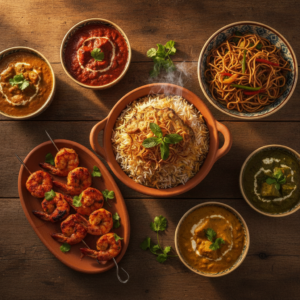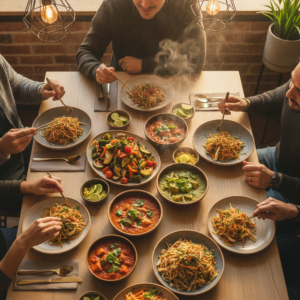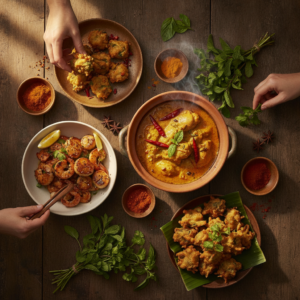
If you’ve ever searched indian food near me for a group dinner and then stared blankly at a menu that spans three pages, you’re not alone. Ordering Indian food for a large party — whether it’s a family reunion, a birthday dinner, or a casual Friday night with colleagues — can feel overwhelming before it even begins. The menu is long, the spice preferences are all over the place, and someone at the table always has a dietary restriction you forgot about. At 7 Spice Bistro, we’ve hosted hundreds of group tables over the years, and we know exactly where the planning tends to fall apart. This guide breaks the whole process down into clear, manageable steps so your next group meal is something everyone actually enjoys.
Quick Answer
To order Indian food for a large group without stress: decide on a shared format (family-style or set menu), assign one person to coordinate dietary needs, balance one or two spicy dishes against milder crowd-pleasers, include a rice or bread base everyone can share, and confirm your headcount and any special requests with the restaurant in advance. These five steps alone will cut your planning time in half.
Why Does Ordering for a Group Feel So Hard?
Group ordering at an Indian restaurant is genuinely more complex than at most other cuisines, and there’s a real reason for that. Indian menus are built around variety — not just one or two signature dishes, but entire categories of proteins, cooking styles, bread types, rice dishes, and accompanying sides that are each designed to complement one another. When eight people are ordering individually, you end up with eight dishes that may not pair well together, uneven portions, and a table that runs out of bread before anyone’s finished their curry.
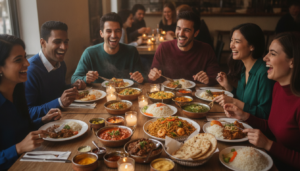
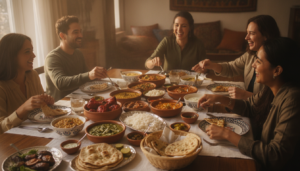
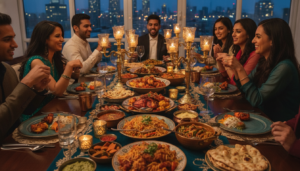
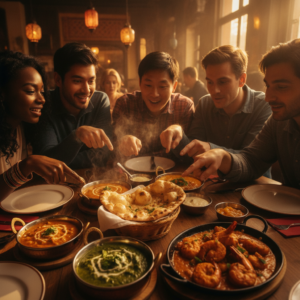
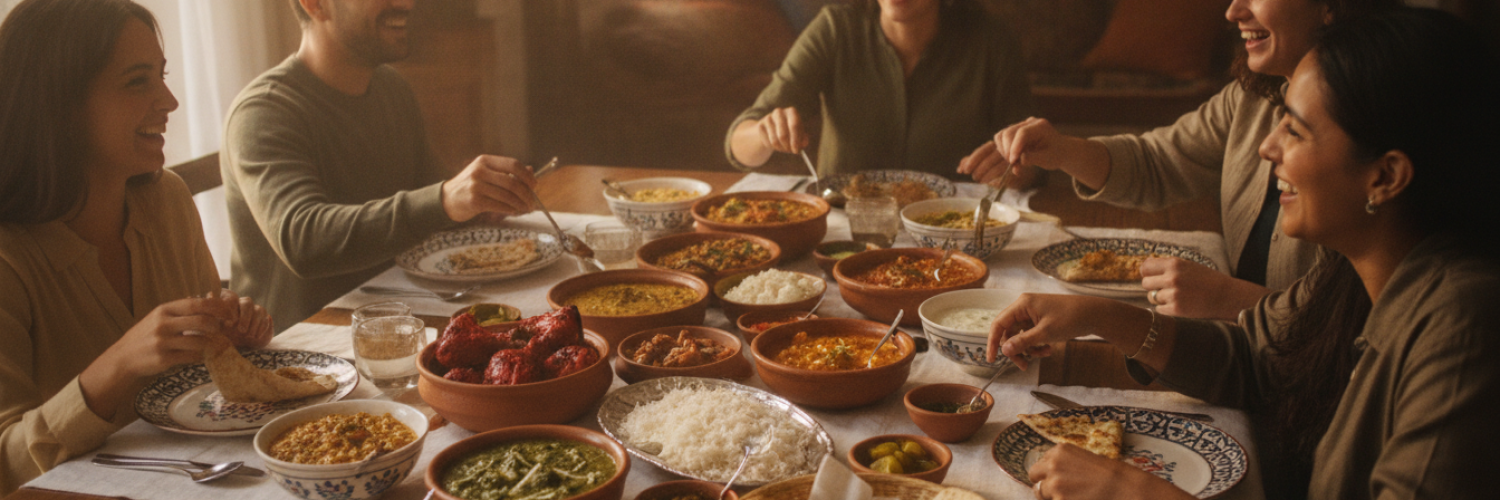
The good news is that Indian food is actually one of the best cuisines for group dining when it’s approached correctly. The family-style format — where dishes are ordered to share across the table rather than individually — is not just culturally appropriate, it’s genuinely more enjoyable. You get to try more of the menu, portion control becomes flexible, and the meal feels more social. The challenge is knowing how to structure that sharing model so it works for your specific group.
At 7 Spice Bistro in Mississauga, we see this dynamic play out regularly. Groups who arrive with a rough plan — even a loose one — have a noticeably better experience than those who try to decide everything at the table. A little preparation, done in the right order, makes all the difference.
How Do You Plan Portions for a Large Indian Meal?
For a family-style Indian meal, a reliable rule of thumb is one main dish for every two people, plus one shared rice or bread option for every three to four people. For a table of eight, that means roughly four mains, two rice dishes or a generous bread basket, and one or two appetizers to start. This ratio keeps the table full without over-ordering and wasting food.
Start by thinking in categories rather than individual dishes. Every well-balanced group order at an Indian restaurant should cover:
- One protein-heavy main — something like a rich curry or a dry preparation that anchors the meal
- One or two lighter or saucy mains — dishes that pair well with rice or bread and are easy to share
- A rice base — plain basmati, a flavoured rice, or a biryani depending on the occasion
- Bread for the table — naan or roti, ordered in rounds rather than all at once
- A starter or two — shared appetizers that give people something to eat while mains are being prepared
If your group is searching for biryani near me specifically, biryani works exceptionally well as a group dish because it’s a complete meal on its own — protein, rice, and spice all in one pot. Order one large biryani as an anchor dish and supplement it with one or two curries and a shared bread basket, and you have a table that’s well-fed without being excessive.
Our team is always happy to help groups plan their order when they call ahead or ask at the table. We’d rather spend two minutes helping you get the portions right than have half the table leave hungry or have food go to waste.
How Do You Balance Spice Levels Across a Mixed Group?
The single most practical approach is to order at least half your dishes at a mild or medium spice level and reserve one or two dishes for guests who prefer more heat. This way, every person at the table has something they can eat comfortably, and those who want more heat aren’t missing out.
Spice tolerance is probably the most emotionally charged part of group ordering at an Indian restaurant. Someone always wants it hotter, someone always wants it milder, and both groups feel like the other is ruining the meal. The practical solution is to stop trying to find one spice level that satisfies everyone and instead structure the order so that different dishes serve different preferences.
Here’s a framework that works well for most groups:
- Mild dishes for the whole table — creamy, coconut-based, or tomato-forward curries tend to be accessible and satisfying without overwhelming heat
- Medium dishes for the middle ground — a good curry at medium heat is flavorful without being aggressive, and most adults enjoy this range
- One hot dish for the spice lovers — ordered specifically for those who want it, clearly communicated to the rest of the table so there’s no surprise
When you’re at the restaurant, tell your server exactly what your group looks like in terms of spice preference. A good server will help you identify which dishes on the menu naturally sit at different heat levels without compromising on flavor. At 7 Spice Bistro, we use fresh, locally-sourced ingredients and age-old recipes, which means spice is integrated into the dish — not just added on top — and that makes a real difference in how balanced the heat feels.
Also worth noting: raita (yogurt sauce) and plain bread are your best friends when someone accidentally takes a bite of the hot dish. Have them on the table before the mains arrive.
What’s the Best Way to Handle Mixed Dietary Needs?
The best approach for mixed dietary needs is to identify restrictions before you arrive, communicate them clearly to the restaurant, and build the order around dishes that naturally work for the most people — rather than treating dietary needs as an afterthought.
Indian cuisine is naturally diverse enough to accommodate a wide range of preferences within a single menu. A group that includes seafood lovers, vegetarians, and meat-eaters can all eat well from the same menu without anyone feeling like they’re eating a compromised version of the meal.
If your group includes seafood fans, the seafood dishes at 7 Spice Bistro are worth highlighting specifically. Fresh seafood prepared with Indian spices offers a completely different texture and flavour profile than meat or vegetable dishes, and it’s an excellent way to add variety to a large group order without duplicating flavour territory. For groups that have never tried Indian-spiced seafood, it’s often the dish people talk about most on the way home.
For groups with vegetarian members, Indian menus offer a genuinely wide selection of substantial vegetable and paneer-based dishes that are satisfying as main courses — not side dishes dressed up. Order these as full mains alongside meat or seafood dishes and they’ll hold their own at the table.
The practical step: before your reservation, send a quick message to your group asking if anyone has dietary restrictions. One message, sent early, saves you from a scramble at the table. When you arrive, let your server know upfront. Our team will steer you toward the right dishes without making anyone feel singled out.
For more guidance on building a satisfying group order from our menu, the 7 Spice Bistro Menu Guide: What to Order First and Why is a useful starting point before you even arrive.
Is It Worth Ordering Hakka Food Alongside Indian Dishes for a Group?
Yes — mixing hakka cuisine with Indian dishes is one of the most practical and crowd-pleasing strategies for large groups, because hakka dishes tend to be bolder and drier in texture, which complements the saucier, more complex profile of traditional Indian curries.
Hakka cuisine, for those unfamiliar with it, is a style of cooking that developed among the Hakka Chinese community and was later adapted and influenced by Indian flavours to create a distinctive Indo-Chinese culinary tradition. It’s one of the most popular comfort food styles in the GTA, and searching for hakka near me or hakka cuisine in Mississauga consistently brings up dedicated fans of the style. At 7 Spice Bistro, we’ve made it a core part of what we offer alongside our Indian menu, and groups consistently tell us it’s the combination that makes the meal feel genuinely different from a standard restaurant night out.
For a group order that mixes both, a reasonable structure is two or three Indian mains, one hakka noodle or rice dish, and one hakka protein preparation. The textures and flavour profiles contrast well, and it gives people who might be newer to Indian food a familiar entry point through the hakka dishes while still experiencing the full range of what the kitchen does best.
Groups searching for the best hakka mississauga has to offer often find us through word of mouth, and once they try the combination of both menus in a single meal, they rarely go back to ordering from just one side.
| Dish Type | Best For | Group Ordering Tip |
|---|---|---|
| Indian Curry (mild/medium) | Whole table, including guests new to Indian food | Order 1 per 2 people; pair with rice or naan |
| Biryani | Groups who want a complete, shareable centrepiece dish | One large biryani anchors the whole table; add 1–2 curries alongside |
| Seafood Dish | Groups wanting variety; seafood lovers in the party | Order as one of your rotating mains; contrasts well with meat curries |
| Hakka Noodles or Fried Rice | Mixed groups; guests less familiar with Indian cuisine | One shared portion works for 4–5 people alongside other mains |
| Hakka Protein Preparation | Spice lovers; guests who want bold, dry-style dishes | Pairs well as a contrast to creamy Indian mains |
How Do You Get the Most Value When Ordering for a Large Group?
The most reliable way to get value from a large group Indian meal is to order family-style rather than individually, communicate with the restaurant ahead of time, and think of the meal as a curated set of dishes rather than a collection of individual orders. This approach reduces waste, stretches the budget, and usually produces a better meal.
When someone in your group searches for good restaurants near me or best food near me and lands on a spot like 7 Spice Bistro, they’re often hoping for a meal that feels special without costing a small fortune. The good news is that Indian cuisine, ordered smartly in a family-style format, is one of the most cost-effective ways to feed a group well. You get genuine variety, generous portions, and flavour that holds up across the entire meal — not just in the first few bites.
A few specific habits that help on the value side:
- Designate one person to coordinate the order. When everyone orders individually and independently, you end up with duplicate dishes and gaps. One person with a list of preferences can build a balanced, varied order in a few minutes.
- Order bread in rounds, not all at once. Bread ordered too early gets cold and takes up table space. Ask for the first round with appetizers and request more as you go.
- Ask the server which dishes are best for sharing. Some preparations hold up better across a table than others. A good server will tell you honestly.
- Call ahead for large parties. If your group is eight or more, a quick call to the restaurant lets the kitchen prepare properly and usually means your food arrives faster and in better condition.
- Consider catering for groups over fifteen. For very large groups — office events, family celebrations, or gatherings — restaurant catering often delivers better value and consistency than a large dine-in party. Our team at 7 Spice Bistro offers full-service catering with personalized packages that can be tailored to your headcount and preferences.
Speaking of catering: if your gathering is large enough that coordinating a restaurant meal feels like a logistical exercise in itself, our catering service removes that entirely. We handle the portioning, the variety, and the presentation — your only job is to enjoy the meal with your guests. For those exploring event options in and around Mississauga, Ontario, it’s worth having that conversation with us before the event rather than scrambling afterward.
“The best group meals we’ve seen at 7 Spice Bistro aren’t the ones with the biggest budgets — they’re the ones where someone took fifteen minutes beforehand to think through the order. A little planning at the front end creates a meal that everyone remembers.”
Families and groups in Mississauga who are looking for a restaurant where the atmosphere is as comfortable as the food should know that our dining room is designed exactly for this kind of gathering. We have free WiFi, a welcoming layout, and a team that genuinely enjoys looking after large tables. If you’ve been searching for an indian restaurant near me that actually accommodates groups well — not just tolerates them — we’d love to show you what that looks like in practice.
For families in the broader GTA area, including those coming from Oakville or Brampton, our location in Mississauga is centrally accessible and worth the drive. If you’re exploring options across the region, the Restaurants in Oakville: What Food Lovers in the City Are Ordering Right Now article gives useful context on what GTA diners are gravitating toward, and Good Restaurants in Mississauga: What Families Should Actually Look For covers exactly what makes a family dining experience genuinely satisfying rather than just adequate.
Also worth checking out if your group is heading our way is the Why Your Next Work Lunch Should Be at an Indian Restaurant in Mississauga piece — it covers the professional group dining experience specifically and has some useful ordering advice that applies equally well to family and social groups.
Ready to Plan Your Group Meal?
Whether you’re bringing eight people or eighty, our team at 7 Spice Bistro is here to help you build an order that works for everyone at the table. Come in, call ahead, or enquire about our catering packages — we’ll take care of the rest.
About the Author
The 7 Spice Bistro Team, Mississauga, Ontario. We’ve spent years serving families, couples, and large groups from across the GTA, and we write from that firsthand experience of watching what makes a group meal genuinely work. Our kitchen and front-of-house staff contribute the insights that go into every piece we publish.
Frequently Asked Questions
How many dishes should I order for a group of ten at an Indian restaurant?
For a group of ten eating family-style, plan for five to six main dishes, two rice preparations or a biryani shared between the table, and a generous bread order. Add two or three appetizers to start. This gives everyone enough variety without over-ordering. If the group includes big eaters or you’re celebrating a special occasion, add one extra main and a dessert to share.
What is the best way to include guests who are new to Indian food in a group order?
The best approach is to anchor the order with one or two mild, creamy, or tomato-based dishes that are accessible and familiar in texture, while keeping bolder and spicier dishes on the table for more experienced diners. Including a hakka noodle or fried rice dish alongside Indian mains also gives newcomers a familiar entry point while they explore the broader menu. Letting your server know in advance that some guests are new to the cuisine means they can flag approachable dishes proactively.
Why is calling ahead important for large group reservations at an Indian restaurant?
Calling ahead allows the kitchen to prepare for your group’s volume and any special requirements, which means your food arrives faster, hotter, and more consistent across all dishes. For groups of eight or more, it also allows the front-of-house team to arrange seating properly so the group isn’t cramped or split across separate tables. At 7 Spice Bistro, a quick call ahead makes a measurable difference in the quality of your group’s experience.
Can I mix Indian and hakka dishes in the same group order?
Absolutely — and for many groups, it’s the best way to structure the order. Indian and hakka dishes complement each other well because hakka preparations are typically drier and bolder in texture, which contrasts nicely with the saucier, more aromatic profile of Indian curries. A mixed order gives your group more variety, suits a wider range of preferences at the table, and makes the meal feel more dynamic than ordering from a single menu category. At 7 Spice Bistro, both cuisines come from the same kitchen and are designed to be enjoyed together.
Written by the 7 Spice Bistro Team
Our team brings deep expertise — Indian and hakka cuisines in Mississauga.