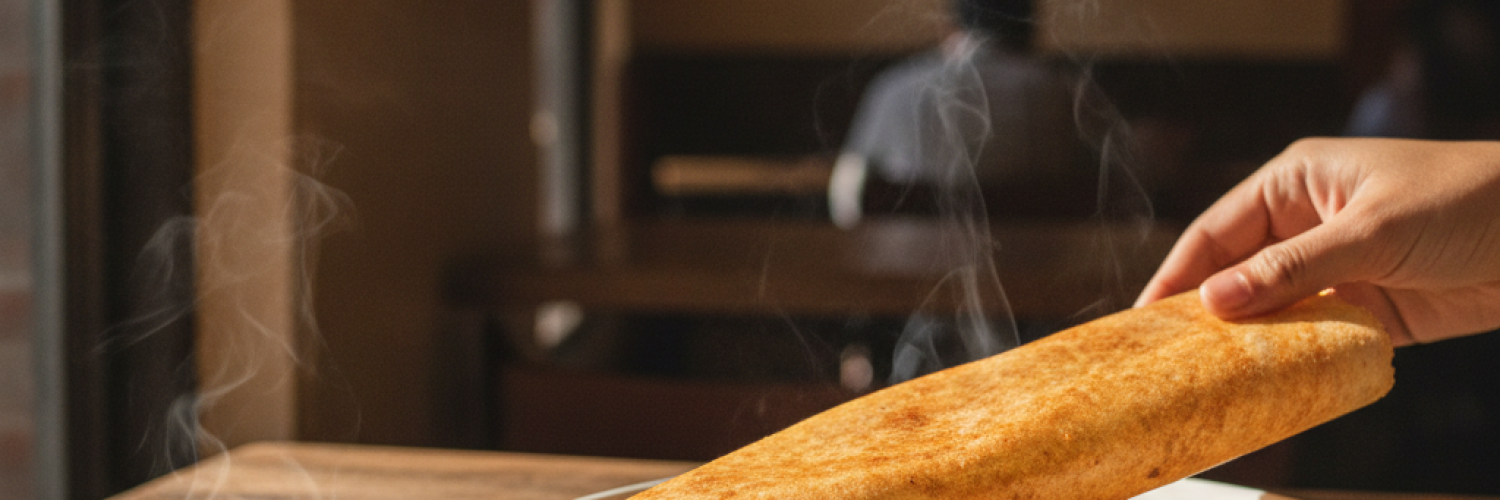
If you’ve ever typed “dosa near me” into your phone on a hungry Tuesday evening, you already know the craving — that pull toward something crisp, warm, and deeply satisfying that no sandwich or pizza can quite replicate. In 2026, dosa has officially crossed over from niche South Indian staple to a dish that GTA diners of every background are actively hunting down, talking about at dinner tables, and ordering on repeat. And yet, for all its rising popularity, a surprising number of people still aren’t entirely sure what a dosa actually is, why it comes in so many forms, or what makes one genuinely good versus merely adequate. This guide is written for exactly those curious diners — the ones who see it on the menu, order it once, and immediately wonder how they went this long without it.
QUICK ANSWER
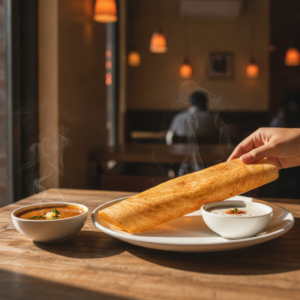
A dosa is a thin, fermented crepe made from a batter of ground rice and lentils, originating in South India. It is naturally gluten-free, cooked on a flat griddle until golden and crisp, and served with chutneys and sambar. It comes in dozens of regional varieties — from the simple plain dosa to the loaded masala dosa stuffed with spiced potato filling. At 7 Spice Bistro in Mississauga, Ontario, our dosa is made with fresh, authentic ingredients and served exactly the way it should be.
What Exactly Is a Dosa, and Where Does It Come From?
A dosa is a fermented rice-and-lentil crepe that originated in the southern regions of India — particularly Tamil Nadu, Karnataka, Kerala, and Andhra Pradesh — and has been eaten for well over a thousand years. The batter is made by soaking raw rice and urad dal (split black lentils) separately, grinding them smooth, combining them, and then allowing the mixture to ferment overnight. That fermentation is not incidental — it is the entire secret. It develops a mild tang, creates air bubbles that produce a porous, lacy texture, and primes the batter for that signature crispness when it hits a hot, lightly oiled griddle.
The word “dosa” itself comes from Tamil, and in South Indian homes it is considered everyday comfort food — breakfast, a light dinner, a snack between meals. What the rest of the world is now catching up to is what South Indian families have known for generations: dosa is one of the most satisfying, versatile, and nutritionally sound dishes you can put on a table. It is high in carbohydrates for energy, rich in plant-based protein from the lentils, and the fermentation process makes it easier to digest than many comparable dishes.
When dosa travelled outside of South India — first to other parts of the country, then to the South Asian diaspora communities in cities like Mississauga, Ontario — it carried its full cultural weight with it. Getting dosa right is not just about mixing batter. It requires the right ratio of rice to dal, the right fermentation time for the local climate, and the practiced confidence to spread a ladleful of batter into a perfectly thin, even circle on a screaming-hot tawa. At 7 Spice Bistro, our kitchen team brings over seven years of experience working with authentic Indian cuisine, and that experience shows in every dosa that leaves our griddle.
How Many Types of Dosa Are There — and What Makes Each One Different?
There are dozens of recognized dosa varieties across South India, each with its own character, texture, and purpose. The differences come from the batter composition, the cooking technique, what goes inside, and how it is served. Here is a breakdown of the most important varieties that any dosa enthusiast — beginner or experienced — should know.
| Dosa Type | Key Characteristic | Typical Filling / Topping | Best For |
|---|---|---|---|
| Plain Dosa | Thin, crisp, no filling | Served with chutney and sambar on the side | Dosa first-timers; light eaters |
| Masala Dosa | Crisp crepe rolled around a spiced filling | Spiced potato and onion (aloo masala) | Most popular variety; satisfying full meal |
| Rava Dosa | Made with semolina; lacy, instant batter | Onions, green chilli, cumin in batter | Those who prefer a slightly different texture |
| Set Dosa | Thick, soft, spongy; served in a set of three | Coconut chutney and vegetable sagu | Those who prefer soft over crispy |
| Pesarattu | Batter made from whole green moong dal | Ginger, green chilli, onion | Andhra Pradesh specialty; high protein |
| Onion Dosa | Finely chopped onions pressed into the batter | Caramelized onion flavour throughout | Savoury flavour seekers |
| Cheese Dosa | Modern fusion variety with melted cheese | Cheese (sometimes with masala potato) | Kids and those new to Indian food |
The masala dosa is, by a wide margin, the variety most GTA diners encounter first — and for good reason. The combination of a shatteringly crisp exterior and the warm, turmeric-yellow potato filling inside is deeply comforting in a way that is almost impossible to explain until you’ve experienced it. If you are searching for the best dosa in Mississauga, understanding which style suits your palate is the first step to ordering with confidence.
Why Do Chutneys and Sambar Matter So Much to a Dosa Experience?
The accompaniments are not optional — they are inseparable from the dish itself. A dosa served without proper chutneys and sambar is incomplete, the same way a burger without a bun is technically still food but entirely beside the point. The three classic accompaniments to dosa are coconut chutney, tomato chutney, and sambar, and each one plays a distinct role in the overall eating experience.
Coconut Chutney
Made from freshly grated coconut ground with green chilli, ginger, and tempered with mustard seeds and curry leaves in hot oil, coconut chutney is cooling and mildly aromatic. It cuts through the richness of the potato filling and provides a textural contrast — smooth and creamy against crisp and starchy. A great coconut chutney is one of the clearest signals that a restaurant takes its South Indian food seriously. Fresh coconut makes all the difference, and using it is a non-negotiable commitment in an authentic kitchen.
Tomato Chutney
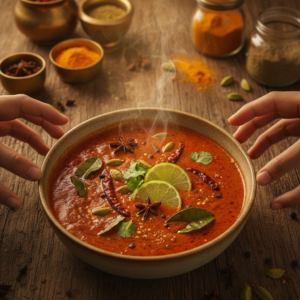
Tomato chutney brings acidity and heat. Cooked down with onions, dried red chillies, tamarind, and sometimes roasted dal, it has a deeper, more assertive flavour than coconut chutney. It pairs beautifully with the plain or onion dosa varieties, where its sharpness can take centre stage rather than compete with a filling.
Sambar
Sambar is a lentil-based vegetable stew seasoned with a complex spice blend called sambar powder, tamarind, tomatoes, and an array of vegetables — drumstick, pearl onion, carrot, eggplant, depending on the region and season. It is served warm, in a small bowl, and the proper technique is to tear off a piece of dosa, dip it into the sambar, and let the lentil broth soak into the batter slightly before eating. Sambar is warming, earthy, and just sour enough to keep every bite interesting. A well-made sambar is the backbone of the South Indian meal — it reflects the cook’s mastery of spice balance more than almost anything else on the table.
“The quality of a restaurant’s sambar tells you more about their kitchen than the main dish does. Anyone can cook a decent dosa. Not everyone can build a sambar from scratch with balanced tamarind, lentils, and layered spice that tastes like it was simmered for hours — because it was.”
At 7 Spice Bistro in Mississauga, we prepare our sambar and chutneys fresh — not from concentrate, not from packet mixes. That is not a marketing claim; it is simply the standard we have held to since we first opened our doors, because we believe authentic indian cuisine cannot be shortcuts and still be authentic.
What Makes a Dosa Great Versus Just Good? The Details That Separate Restaurants
A great dosa and a merely adequate one can look identical on a plate. The difference lives in a handful of technical details that experienced diners sense immediately, even if they can’t always name the reason.
Fermentation time and environment. The batter needs to ferment for the right amount of time — typically eight to twelve hours — and that duration shifts depending on the ambient temperature of the kitchen. In the warmer months in Mississauga, Ontario, the batter can over-ferment quickly if not watched. In the colder winter months, it may need longer. Getting this right consistently, batch after batch, is a skill built over years, not weeks.
The tawa temperature. The cast iron or smooth steel griddle — called a tawa or dosa griddle — must be at the correct temperature before the batter hits it. Too cool, and the dosa steams rather than crisps. Too hot, and it scorches before the centre cooks through. An experienced dosa cook reads the tawa by instinct, adjusting the flame and the pour in real time.
The spreading technique. You pour the batter at the centre and immediately use the back of a ladle to spiral it outward in a single, fluid motion — thin at the edges, slightly thicker toward the middle. There is no second chance. If the spread is uneven, the dosa will be uneven. This is a motion that takes months to make look effortless.
The masala filling quality. For masala dosa specifically, the potato filling must be seasoned with mustard seeds, curry leaves, turmeric, green chilli, and sautéed onion — not just mashed potato with powder thrown in. The onions should be soft and sweet, the potato tender but not gluey, the colour a warm golden yellow from fresh turmeric.
When you are searching for indian food near me and dosa is on the menu, these are the details worth paying attention to. A restaurant that takes its dosa seriously tends to take everything else seriously too. You can explore more of what thoughtful Indian cooking looks like across the city in our post on Dining Out in Mississauga: A Neighbourhood-by-Neighbourhood Food Guide, which breaks down the dining landscape across different parts of the city.
Where to Find the Best Dosa in Mississauga — and Why It Matters to Us
If you are searching for the best dosa in Mississauga or simply looking for great indian near me and want to try South Indian cuisine for the first time, the answer to where you end up matters more than it might seem. Dosa done right is a genuinely memorable meal. Dosa done carelessly is just a thin, slightly sour pancake. The gap between those two outcomes is real, and it is why we take this so seriously at 7 Spice Bistro.
7 Spice Bistro is located in Mississauga, Ontario, and has been serving families, couples, and professionals across the Greater Toronto Area for over seven years. Our menu spans both Indian and Hakka cuisines — two traditions that we believe deserve equal care and attention — and our dosa is prepared the way it has always been prepared: from a properly fermented batter, spread thin on a well-seasoned griddle, and served immediately with chutneys and sambar made in-house. We use fresh, locally sourced ingredients wherever possible, because the flavour difference between fresh and pre-processed is not subtle — it is the entire point.
Our restaurant is designed to be a welcoming space — not a quick-service counter, not an upscale white-tablecloth experience, but something warmer and more genuine than either. Families come in on Sunday afternoons and linger. Couples find their corner table and order slowly. Professionals who work nearby stop in because they know they can count on consistency. That is the kind of place we have always wanted to be. We also have free WiFi for those who need to work between bites, and we offer full-service catering and event packages for those who want to bring this food to a larger gathering — including weddings. If you are building a spread for a celebration, our post on Biryanis, Curries, and Kebabs: How to Build the Perfect Indian Feast for a Group is a practical guide to thinking through an Indian feast at scale.
We are also proud to offer seafood dishes alongside our Indian and Hakka menu — because coastal South Indian cuisine has always had a rich relationship with the sea, and our seafood preparations honour that tradition. If you are curious about how seafood fits into this broader culinary story, check out our piece on Seafood Chowder Recipe: Everything to Know Before You Decide for a deeper look at one of our favourite preparations.
Mississauga has grown into one of the most culinarily rich cities in Canada, with a South Asian community that has brought generations of cooking tradition to this region. We feel fortunate to be part of that community and that story. If you are looking for 7 Spice Bistro in Mississauga — whether for a dosa, a full biryani spread, or catering for your next celebration — we would love to have you at our table.
Ready to Try the Best Dosa in Mississauga?
Come in for dine-in, explore our full Indian and Hakka menu, or speak with our catering team about your next event. We are located in Mississauga, Ontario, and we welcome families, couples, and groups of all sizes.
✍️ Written by the 7 Spice Bistro Team — We are the kitchen, the front of house, and the people who genuinely care about every plate that leaves our restaurant in Mississauga, Ontario. With over seven years of experience in authentic Indian and Hakka cuisine, we write about food because we live it every single day.
Frequently Asked Questions
What is the difference between a plain dosa and a masala dosa?
A plain dosa is the base form — a thin, crisp fermented rice-and-lentil crepe served with chutney and sambar and no filling. A masala dosa contains a filling of spiced mashed potato with onions, mustard seeds, turmeric, curry leaves, and green chilli rolled inside the crepe. The masala dosa is the most widely recognized variety outside of South India and is often a first-timer’s introduction to the dish.
How is dosa batter made, and why does fermentation matter?
Dosa batter is made by soaking raw rice and urad dal (split black lentils) separately for several hours, grinding them to a smooth consistency, combining them, and then leaving the mixture to ferment at room temperature for eight to twelve hours. Fermentation is essential — it develops a mild sourness, creates air bubbles that give the dosa its characteristic porous, crisp texture, and improves digestibility by breaking down starches and phytic acid in the grains.
Why is sambar served with dosa rather than eaten separately?
Sambar — a warm lentil and vegetable stew seasoned with tamarind and sambar powder — serves as a flavour contrast and textural complement to the dry, crisp dosa. The traditional technique is to dip torn pieces of dosa into the sambar so the broth soaks slightly into the batter, combining the tangy, earthy depth of the stew with the neutral crispness of the crepe. Together, the two form a complete flavour experience that neither achieves alone.
Can I order dosa as part of a catering package at 7 Spice Bistro?
Yes — 7 Spice Bistro offers full-service catering with personalized menu packages for weddings, corporate events, and private celebrations. Our catering team works with you to build a menu that reflects your event’s needs, and South Indian dishes including dosa can absolutely be part of that spread. Reach out to us directly through our website at 7 Spice Bistro to discuss your event and get a custom package put together.