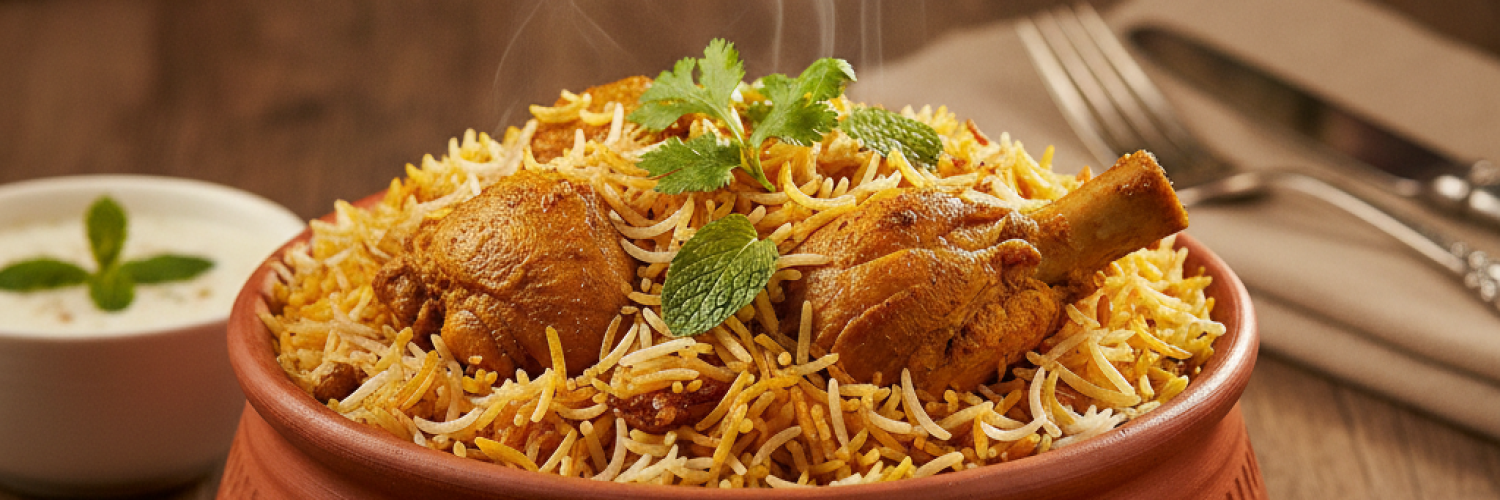
Why “Chicken Biryani Near Me” Is One of the Most Searched Phrases in the GTA — And Why It Matters
If you’ve ever typed chicken biryani near me into your phone late on a Friday night, you already understand something important: not all biryanis are created equal. In 2026, the GTA’s dining scene is more crowded than ever, and finding a plate of biryani that actually earns the name can feel like searching for a needle in a haystack. Mississauga alone has dozens of spots claiming to serve the “real thing” — but genuine, soul-satisfying chicken biryani is rarer than it should be.
At 7 Spice Bistro, we’ve spent seven years perfecting our chicken biryani using age-old recipes and fresh, locally-sourced ingredients right here in Mississauga, Ontario. We hear it from our guests constantly: they came in searching for biriyani near me and left having found their new favourite table. So we decided to write the guide we wish existed — a no-nonsense checklist of exactly what separates a biryani made with craft and care from one that simply wears the label.
Whether you’re a seasoned biryani lover or a curious newcomer exploring Indian cuisine for the first time, these seven markers will help you spot quality before you even take a single bite.
⚡ QUICK ANSWER
An authentic chicken biryani should have long-grain rice cooked to separate, fluffy perfection, deeply marinated chicken, a visible dum (slow-steam) layering technique, a complex aroma from whole spices, a rich golden colour from saffron or turmeric, a balanced moisture level (never soupy, never dry), and a finish that lingers on the palate. If a biryani ticks all seven of these boxes, it was made the right way.
1. What Does Properly Cooked Rice Actually Look Like in a Real Biryani?
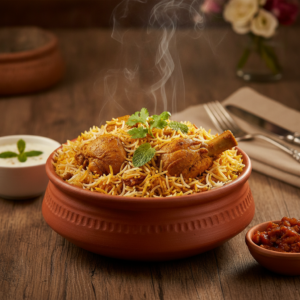
The rice is the foundation, and properly cooked biryani rice should be long, separate, and slightly firm — never clumped, never mushy. Each grain stands on its own. This is the first and fastest visual test you can perform before you’ve even lifted a fork.
Authentic biryani is built on aged basmati rice, soaked, parboiled, and then finished in layers over the meat. The partial cooking before layering is non-negotiable — it’s what gives each grain that signature elongation and bite. When rice is added raw or over-boiled, it collapses into a starchy mass. That might still taste fine, but it isn’t biryani in the true sense of the word.
Look at the texture. Run a spoon through the rice and watch what happens. Grains that fall apart individually, with no gluey strands connecting them, tell you that the cook understood the technique. Grains that clump and drag tell you they didn’t. It sounds simple, and it is — this single visual cue eliminates most mediocre biryani immediately.
2. How Deep Should the Chicken Marinade Actually Go?
Great biryani chicken should be flavoured all the way to the bone, not just on its surface. Marinade depth is the difference between chicken that tastes like a seasoned afterthought and chicken that carries the entire dish.
Authentic chicken biryani requires the meat to sit in a marinade — typically yogurt, aromatics, and ground spices — for a minimum of several hours. Overnight is better. The yogurt tenderises the protein while the spices work inward, so that when the chicken hits the heat of the dum pot, the flavours have already taken root deep inside the meat.
A simple test: pull a piece of chicken apart at the table and look at the cross-section. The interior should carry colour and spice — not a pale, unmarinated grey. The meat should be tender enough to pull cleanly from the bone without effort, and each bite should deliver a warm, layered spice note rather than a flat, one-dimensional taste. When our team at 7 Spice Bistro preps chicken biryani, the marinade process starts well before service — because shortcuts here are visible and edible.
3. Why the Aroma of a Biryani Tells You Almost Everything Before You Taste It
A properly made biryani should announce itself — the aroma of whole spices, caramelised onions, and slow-cooked chicken should reach you before the plate does. If a biryani smells flat or predominantly of rice, something is missing at the foundation.
Whole spices are the engine of biryani’s signature scent. Bay leaves, green cardamom, cloves, cinnamon sticks, and star anise are bloomed in ghee or oil at the very beginning of the cooking process. These release fat-soluble aromatic compounds that coat every layer of the dish as it cooks. Ground spice blends alone — while useful — cannot produce the same multi-dimensional fragrance because many volatile compounds in whole spices evaporate quickly when the spice is pre-ground.
When a biryani arrives at your table and you lift the lid or open the foil seal, close your eyes for a second. You should smell warmth, complexity, and depth — a mix of floral, woody, and savoury notes all at once. That aromatic greeting is the hallmark of a cook who hasn’t cut corners on the spice base. It’s one of the reasons guests searching for biryani near me often say they knew 7 Spice Bistro was the right call the moment the plate arrived.
“The aroma of a great biryani is not a garnish — it’s a promise. If the scent is rich and layered before you’ve taken a bite, the cook has already done most of the work right.”
4. What Is Dum Cooking and Why Does It Separate Good Biryani from Great Biryani?
Dum is the slow-steam finishing technique that defines authentic biryani — without it, you have spiced rice with chicken, not biryani. The word “dum” comes from the Persian for “breath,” referring to the way the dish breathes and self-bastes inside a sealed pot.
In dum cooking, partially cooked rice is layered over marinated, half-cooked chicken inside a heavy-bottomed pot. The pot is sealed tightly — traditionally with dough, though foil and tight-fitting lids work just as well — and placed over a low, controlled heat. The steam trapped inside does the final cooking, allowing the moisture from the chicken and its juices to travel upward through the rice, infusing every layer with flavour. No stirring, no shortcuts.
You can often tell if dum was used by how the dish is served. A biryani brought to the table still sealed — opened tableside — strongly suggests the dum process was honoured. The steam that escapes when you break the seal is part of the experience. More importantly, the layering inside the pot should be visible: rice on top with distinct colour gradients, caramelised onions and herbs visible throughout, and chicken nestled at the base with its juices absorbed into the grains above. That layering is the fingerprint of the dum method — and it’s one of the clearest signs you’ve found the best biryani in Mississauga.
If you want to go deeper on building the perfect Indian feast around a dum biryani, our team has put together a full guide worth reading: Biryanis, Curries, and Kebabs: How to Build the Perfect Indian Feast for a Group.
5. Is Colour a Reliable Indicator of Biryani Quality?
Yes — colour in a biryani is meaningful, not decorative, and a well-made biryani should display a natural gradient of golden, ivory, and amber tones across the rice. Uniform colour is actually a warning sign, not a feature.
Authentic colour in biryani comes from two sources: saffron bloomed in warm water or milk and drizzled over the top layer of rice, and caramelised onions (birista) folded through the layers. Both contribute a genuine golden-to-amber warmth that is uneven by design — some grains are deeply coloured, others remain ivory-white, and the mix across the dish tells the story of how it was constructed layer by layer.
A biryani that is uniformly yellow from base to top has likely been coloured with food dye or turmeric added to the cooking water rather than applied through the proper layering process. It may look dramatic, but the visual uniformity is a technical giveaway. Conversely, a biryani that is entirely pale with no colour variation suggests the aromatic finishing steps were skipped entirely. The right biryani looks like a mosaic — a deliberate, beautiful patchwork of colour that reflects the care taken in assembly.
6. How Should a Proper Biryani Feel — What’s the Right Moisture Balance?
Authentic chicken biryani should be moist but never wet — the rice should feel lightly coated by the chicken’s juices without pooling at the bottom of the dish. Moisture balance is one of the most technically demanding aspects of the recipe and one of the easiest to get wrong.
Too much liquid added to the dum pot results in rice that finishes waterlogged and bloated, breaking apart and losing its shape. Too little, and the rice dries out in the sealed heat, becoming crunchy or chalky at the base. The sweet spot requires experience — knowing exactly how much moisture the marinated chicken will release during cooking and calibrating the parboiling level of the rice accordingly.
At the table, you can test this by spooning up a portion and watching the base of the serving dish. If liquid runs and pools freely, the dish is over-wet. If the rice scrapes up stiff and dry, it’s been cooked without enough moisture exchange. The ideal plate should glisten lightly — each grain separate, slightly glossy from the spiced cooking juices, but never swimming. This balance is something our team in Mississauga, Ontario works to get right every single service, because it’s the difference between a good plate and a memorable one.
Curious about how other dishes at our table pair with biryani? Take a look at how we approach seafood cooking at 7 Spice Bistro: Seafood Chowder Recipe: Everything to Know Before You Decide.
7. What Does a Great Biryani Finish — and Why Does It Linger?
A truly great biryani leaves a warm, spiced finish on the palate that evolves after you swallow — it doesn’t end abruptly. The lingering quality is the mark of a dish where spice has been built thoughtfully at every stage, not dumped in at a single point.
The layering of spice in an authentic biryani is cumulative. Whole spices in the oil at the start. Ground spices in the marinade. Fresh herbs — mint and coriander — folded through the rice layers. Fried onions for sweetness and bitterness at once. Each element adds a different spice note at a different moment in the cooking, so when you eat the finished dish, the flavour arrives in waves rather than all at once.
This is why a well-made biryani served with a simple raita — cooling yogurt with cucumber and cumin — feels so satisfying. The raita doesn’t compete with the biryani; it punctuates it, giving your palate a reset between bites so you can experience the biryani’s complexity again and again. If you find yourself eating more slowly than usual, savouring each forkful and reluctant to rush to the end, that’s the clearest sign of all: the biryani was made the right way.
For anyone exploring the full landscape of what Mississauga’s dining scene has to offer beyond biryani, we recommend checking out: New Restaurants in Mississauga: What Food Lovers Are Excited About This Year.
Where to Find the Best Biryani Near Me in Mississauga
When you’re searching for the best biryani near me and you’re anywhere in Mississauga or the broader GTA, the seven markers above are your compass. They apply universally — at a street-level takeout window or a full sit-down restaurant — and they will never steer you wrong.
At 7 Spice Bistro in Mississauga, Ontario, our chicken biryani is built on every one of these principles. We use age-old recipes brought forward with fresh, locally-sourced ingredients, marinate overnight, cook using the dum method, and finish with real saffron and handmade birista. It’s the same approach we’ve taken since day one, seven years ago, and we have no intention of changing it.
We serve families, couples, and professionals from across the Greater Toronto Area who want Indian food that tastes like it was made by someone who actually cares — without paying a premium price for the privilege. Whether you’re dining in with us on a weekday evening, planning a weekend gathering, or looking for full-service catering for a wedding or special event, our team is here to make it memorable. If you’ve been typing best biryani in Mississauga and not quite finding what you’re looking for, we genuinely believe your search ends here. Our 7 Spice Bistro menu goes well beyond biryani — from rich curries and Hakka specialties to fresh seafood dishes — but biryani is where our heart is, and it shows on every plate.
The next time someone in your circle searches biriyani near me or indian restaurant near me and ends up at our door, we hope this guide has already set the right expectations — because we intend to meet every one of them.
Ready to Experience Biryani Made the Right Way?
Join us at 7 Spice Bistro in Mississauga, Ontario for dine-in, or ask about our full-service catering packages for weddings and events. Authentic Indian and Hakka cuisine, fresh ingredients, and a warm welcome — every single time.
✍️ Written by the 7 Spice Bistro Team — With seven years of serving authentic Indian and Hakka cuisine in Mississauga, Ontario, our team brings hands-on kitchen knowledge and a genuine love of food to everything we write. We share what we know because great food deserves to be understood, not just eaten.
Frequently Asked Questions
How do I know if a chicken biryani was cooked using the dum method?
You can tell by the layering and aroma. A dum-cooked biryani arrives sealed or is opened tableside, releasing a burst of steam. Inside the pot or serving dish, you’ll see distinct layers — golden rice on top, spiced chicken at the base, with coloured and white rice grains visible throughout rather than a uniform mix. The moisture level will also be balanced, since dum cooking lets the chicken’s own juices rise through the rice naturally. If the dish looks and smells like it was assembled in a hurry and stirred together, dum was likely skipped.
What makes 7 Spice Bistro’s biryani different from other Indian restaurants near me in Mississauga?
At 7 Spice Bistro, our biryani is grounded in seven years of experience using age-old recipes and fresh, locally-sourced ingredients right here in Mississauga, Ontario. We marinate the chicken overnight, use the proper dum layering technique, and finish with real saffron and handmade caramelised onions. We don’t scale corners to speed up service — each biryani is prepared with the same care whether it’s a quiet Tuesday dinner or a full catering order for a wedding. That consistency is what keeps guests coming back.
Why does my biryani sometimes taste flat even when it smells good?
Aroma and flavour come from different compounds, and a biryani can smell wonderful while tasting flat if the spice layering wasn’t built at every stage of cooking. A strong surface aroma often comes from finishing garnishes like fried onions or whole spices added late, but if the marinade was shallow or the base cooking oil wasn’t properly spiced at the start, the interior flavour will be thin. Flat-tasting biryani is usually a sign that shortcuts were taken in the marinade or the early cooking stages — the aroma masks it until you eat.
Can I order catering for a large event and still expect the same quality biryani as the dine-in menu?
Absolutely. At 7 Spice Bistro, our catering service — including wedding packages and large-scale event catering — uses the exact same recipes, marinades, and cooking methods as our dine-in kitchen. We offer personalised catering consultations so you can build a menu that works for your guest count and event style, and our team handles everything with the same attention to detail that defines our daily service. Quality doesn’t scale down just because the quantity scales up.